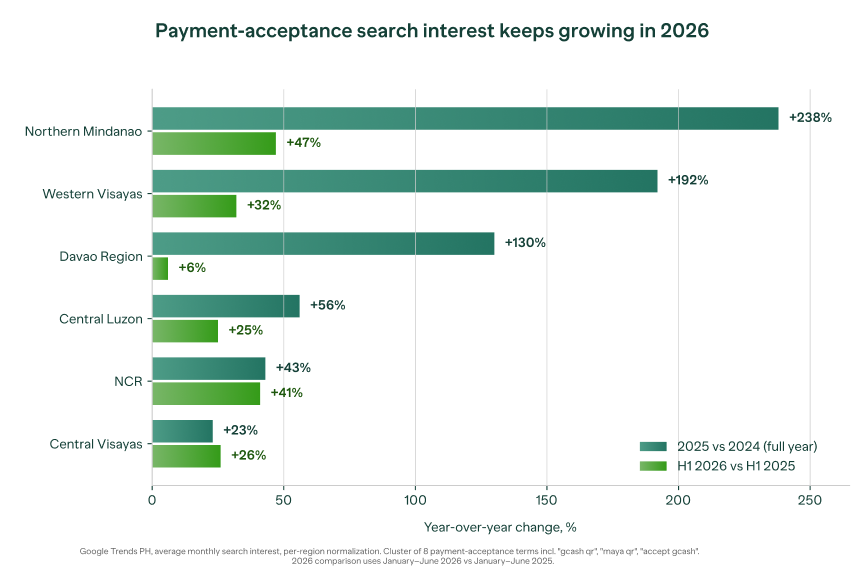
Search interest in accepting digital payments grew fastest in Northern Mindanao, Western Visayas and Davao in 2025 – outpacing Metro Manila roughly 3-5.5x – and kept climbing into 2026.
Interest in digital payment acceptance among businesses outside Metro Manila has reached its highest level in five years, according to PayMongo's analysis of Google Trends data. The study underscores growing demand for digital payment solutions across Philippine provinces.
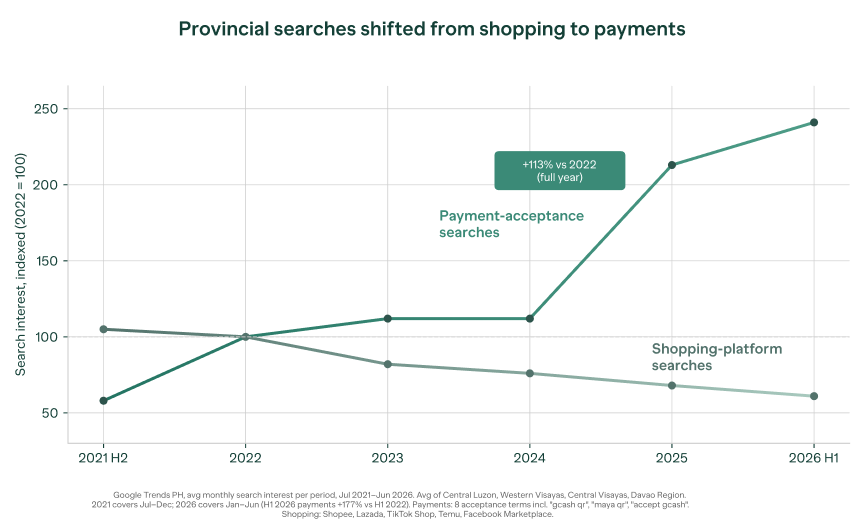
Across major provincial regions, search interest in payment-acceptance terms – including "accept maya,” "accept gcash,” “accept qrph,” and “accept payments online” – has nearly tripled since 2022, with search interest in the first half of 2026 running 177% above the same period in 2022, on average across Central Luzon, Western Visayas, Central Visayas and the Davao Region.
But the growth has accelerated sharply since 2025. Payment-acceptance search interest rose 238% year-over-year in Northern Mindanao, 192% in Western Visayas and 130% in the Davao Region, compared with 43% in the National Capital Region. Search interest in "gcash qr" reached its five-year peak in Western Visayas in May 2026, in Northern Mindanao in October 2025 and in the Davao Region in April 2025.
From shoppers to sellers
Searches for shopping platforms such as Shopee and Lazada declined 37% between the first half of 2022 and the first half of 2026 as post-pandemic e-commerce behavior normalized and moved in-app.
The decline does not mean Filipinos are shopping less online; rather, the two-marketplace era is giving way to a more fragmented landscape. Challenger platforms' share of shopping searches grew 5x since 2022, and the parallel surge in payment-acceptance searches suggests a growing cohort of sellers transacting outside the big marketplaces entirely, perhaps through social channels, their own online stores and in-store QR, where accepting payments directly becomes essential. PayMongo's mid-year data shows the same trend: completed transactions across its merchant network grew 89% from H1 2025 to H1 2026, with its merchant base nearly doubling (+93%) over the same period.
In the Davao Region, breakout growth in searches for platform "seller center" tools, alongside rising "accept gcash" interest across provinces, indicates provincial Filipinos are increasingly setting up shop online, not just buying.
Meanwhile, early signs of a new entrepreneurship cycle are also appearing in the capital: searches for "online business ideas," "how to sell online" and related terms in Metro Manila grew 59% in the first half of 2026 versus the same period in 2025.
The analysis also found an emerging second wave of QR adoption: search interest in "maya qr," minimal before 2024, has since multiplied in Metro Manila, Central Luzon, and Central Visayas, suggesting QR payments are becoming a multi-provider habit consistent with the Bangko Sentral ng Pilipinas' QR Ph interoperability agenda.
Provincial shoppers embrace challenger platforms
Provincial e-commerce is also diversifying. Challenger platforms like TikTok Shop, Temu, and Facebook Marketplace grew from roughly 2% of shopping-platform searches in 2022 to 8–13% today, with Eastern Visayas (13%), Central Visayas and Davao (12% each) ahead of Metro Manila (10%). Mega-sale culture also held: the November–December search lift around 11.11 and 12.12 sales remained steady or strengthened in most regions between 2022 and 2025.
Conclusion
Five years of Google Trends data show the Philippines' digital commerce boom didn't end after the pandemic. Instead, it changed form and moved south. Shopping-platform searches declined everywhere as browsing normalized, but digital payment-acceptance searches nearly tripled between 2022 and early 2026 in provincial regions, growing three to five times faster in Northern Mindanao, Western Visayas, and Davao in 2025 than in Metro Manila, and climbing further still in every region measured in the first half of 2026.
Methodology
Analysis is based on Google Trends monthly search-interest data for the period July 2021 to June 2026, retrieved July 16, 2026, for nine Philippine regions: NCR, Calabarzon, Central Luzon, Western Visayas, Central Visayas, Eastern Visayas, Northern Mindanao, Davao Region, and BARMM. Google Trends values are normalized (0–100) within each region and term set; figures reflect relative search interest, not absolute search volumes. Provincial growth rates are computed from lower absolute search-interest baselines than NCR's; part of the provincial–NCR growth differential reflects base effects typical of earlier-stage adoption.
The payment-acceptance cluster comprises eight terms: "gcash qr," "maya qr," "accept gcash," "accept maya," "accept qrph," "accept qr ph," "accept online payment" and "accept payment online." The shopping cluster comprises Shopee, Lazada, TikTok Shop, Temu and Facebook Marketplace. The online-business cluster comprises eight terms including "how to sell online," "online business ideas," "how to start online business" and "online negosyo."
Within the dataset, 2021 covers July–December and 2026 covers January–June; partial-month data for July 2026 was excluded. Year-over-year comparisons use complete calendar years (2022–2025), while 2026 comparisons match January–June 2026 against the same months of the comparison year.
Regional index averages use the four regions with statistically meaningful 2022 baselines. Northern Mindanao is excluded from the 2022-indexed average because its 2022 baseline falls below the reliability threshold; its year-over-year figures compare 2025 against 2024, where baseline volumes are sufficient.
About PayMongo
PayMongo Group is a fintech company that provides a financial operating system for growing businesses in the Philippines. It enables merchants to accept payments, move money, and borrow capital through a single, unified platform. From startups and SMEs to enterprises, thousands of Filipino merchants across retail, food, e-commerce, and services trust PayMongo to run their financial infrastructure. PayMongo is regulated by the Bangko Sentral ng Pilipinas (BSP) and is PCI-DSS 4.0 and SOC 2 Type 2 certified.