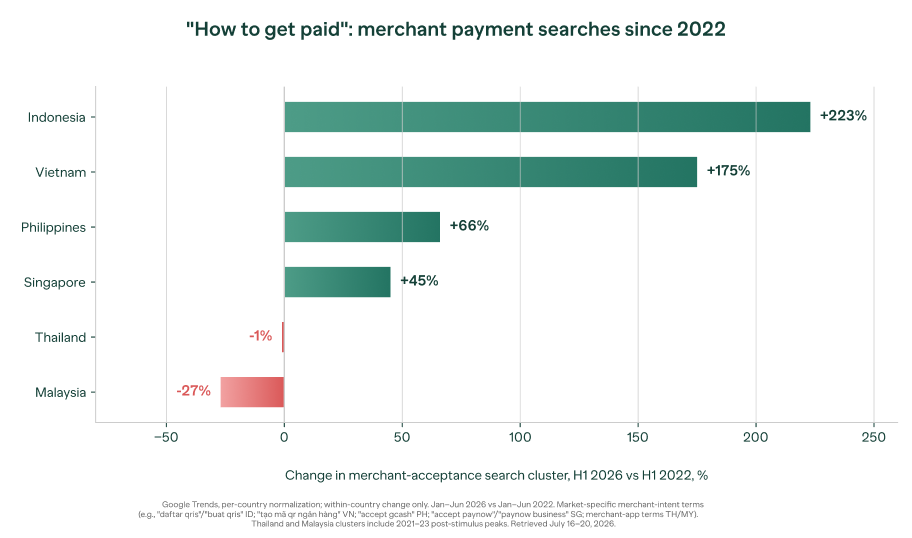
Searches for accepting digital payments more than tripled in Indonesia and nearly tripled in Vietnam since 2022, with the Philippines and Singapore climbing steadily.
As digital commerce matures in Southeast Asia, its sellers are searching for how to get paid, according to a PayMongo’s analysis of five years of Google Trends data across six markets: Singapore, the Philippines, Indonesia, Malaysia, Thailand, and Vietnam.
Comparing the first half of 2026 with the same period in 2022, merchant-intent searches (the terms sellers type when they want to accept digital payments) rose 223% in Indonesia, 175% in Vietnam, 66% in the Philippines, and 45% in Singapore.
The fastest-growing terms in the region are unambiguous about what sellers want: "accept PayNow" in Singapore is up more than tenfold, "buat QRIS" (translation: create a QRIS code) is up 626% in Indonesia, and "tạo mã QR ngân hàng" (create a bank QR) is up 215% in Vietnam.
Region-wide QR Payment Adoption
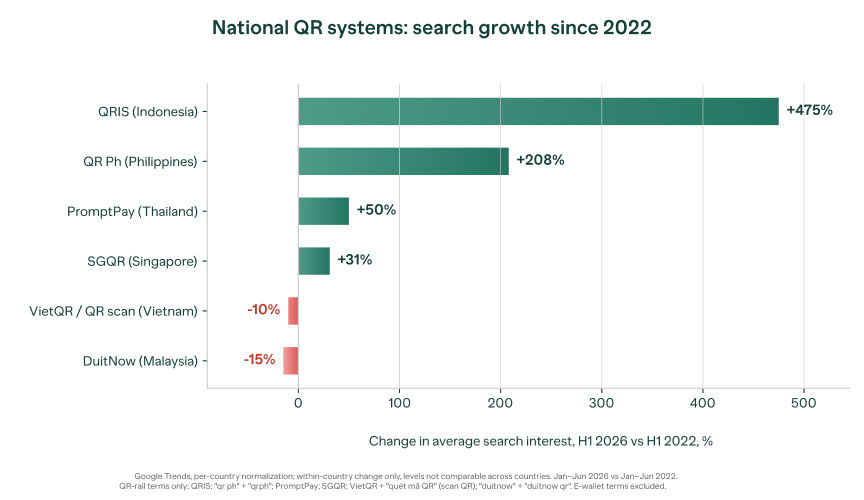
The shift is most evident in searches for each country's national QR payment system.
Interest in Indonesia's QRIS grew 475%, making it the region's fastest. The Philippines follows: QR Ph searches more than tripled (+208%), and merchant phrases like "accept QR Ph" only began registering from 2025, the signature of an acceptance wave still gathering. Thailand's PromptPay, the region's oldest rail, grew a steady 50%; Singapore's SGQR rose 31%.
Singapore shows what a late-stage market looks like from the seller's side. Its rails are the region's oldest and its corporates digitized years ago, searches for "paynow corporate," the banks' formal term, are down 61%, but "accept paynow" is up more than tenfold as hawkers, freelancers and micro-sellers arrive last.
Vietnam splits the story in two. Consumer-side searches for "quét mã QR"(how to scan a QR code) eased from their pandemic-era highs, the signature of a habit already learned. Merchant-side QR creation moved the opposite way: "tạo mã QR ngân hàng" (create a bank QR) is up 215% since the first half of 2022, while "tạo mã VietQR" and "mã QR nhận tiền" (QR to receive money) – both barely registering in 2022 – are at their five-year peaks today. Consistent with a market where consumer scanning is already habitual, it's the sellers who are rushing in.
Malaysia and Thailand show the other end of the curve. Both compressed merchant onboarding into their pandemic-era e-wallet stimulus programs, and searches have eased since: DuitNow is down 15% from its 2023 peak, with attention consolidating onto the interoperable rail after wallet-by-wallet adoption finished.
The pattern is consistent: search growth is steepest where merchant onboarding is most recent – whether that's a whole market, as in Indonesia and the Philippines, or the last segment of an established one, as in Singapore.
And in every market where payment searches are still climbing, Indonesia, the Philippines, Vietnam and Singapore, the merchant side of QR is now growing faster than the consumer side.
Meanwhile growth within wallets now belongs to challengers. Vietnam's ZaloPay more than doubled (+115%); in the Philippines, Maya's payment searches grew roughly twenty-five-fold from a near-zero 2022 base, while GCash, the region's most established wallet in search terms, grew a steady 35%. Meanwhile, Dana for Business in Indonesia grew by 35%.
That said, five years of search data point in one direction: Southeast Asia's sellers are moving to digital payments, and its national QR systems are where they're landing. Indonesia and Vietnam are surging, the Philippines and Singapore are climbing steadily, while Thailand and Malaysia, whose merchant adoption was compressed into the pandemic-era stimulus programs, have already crested.
The shift is consistent with the region's central-bank digitization agendas, from Bank Indonesia's QRIS targets to the Bangko Sentral ng Pilipinas' digital transformation roadmap.
Methodology
Data source and scope: Analysis is based on Google Trends monthly search-interest data covering July 2021 to July 2026, retrieved between July 16 and 20, 2026, at country level for six markets: the Philippines, Indonesia, Thailand, Vietnam, Malaysia and Singapore. These six markets comprise substantially all of ASEAN's digital-payments search activity measurable through Google Trends; remaining ASEAN markets were assessed and excluded for insufficient search volume or non-representative internet usage patterns. Google Trends values are normalized on a 0–100 scale within each country and term set, where 100 represents peak interest for that query set in that country over the period. Figures reflect relative search interest within each country, not absolute search volumes, and levels are not comparable across countries; only within-country changes over time are reported.
Comparison method: Growth figures compare average monthly search interest in January–June 2026 against January–June 2022, matching identical six-month periods to remove seasonal effects. Partial-month data for July 2026 was excluded from all calculations. Percentage changes are reported only for terms and clusters with reliable baseline volumes in the comparison period; terms first registering after 2022 are described as newly emerging rather than assigned growth rates.
Term clusters: Merchant-acceptance clusters use market-specific terms reflecting each market's payment vocabulary: Philippines ("accept gcash," "accept maya," "gcash payments," "maya payments," "accept qrph," "accept qr ph," "qrph payments," "how to accept gcash online"); Indonesia ("daftar qris," "buat qris," "gopay merchant," "daftar gopay merchant," "ovo merchant," "dana bisnis"); Vietnam ("tạo mã qr ngân hàng," "tạo mã vietqr," "mã qr nhận tiền," "nhận thanh toán momo," "momo doanh nghiệp" and related terms); Singapore ("accept paynow," "accept grabpay," "accept paylah," "paynow business," "paynow corporate," "sgqr merchant"); Thailand (merchant-app and acceptance terms including "ถุงเงิน," "แม่มณี," "พร้อมเพย์ร้านค้า," "รับเงินโอน"); Malaysia ("tng merchant," "duitnow qr payment" and related acceptance terms, retrieved in a dedicated pull on July 20, 2026). National QR-rail comparisons use QR-specific terms only: QRIS, "qr ph" + "qrph," PromptPay, SGQR, VietQR + "quét mã QR," and "duitnow" + "duitnow qr." E-wallet comparisons use wallet-specific payment and acceptance terms per market (e.g., GCash and Maya terms in the Philippines; Momo and ZaloPay in Vietnam; DANA, GoPay and OVO terms in Indonesia; GrabPay and PayLah! in Singapore; Touch 'n Go and Boost in Malaysia; TrueMoney in Thailand), excluding national QR rails and bank-transfer systems.
Measurement limitations: Some payment terms in Malaysia, Thailand, Indonesia and Singapore fall below Google Trends' minimum reporting threshold; figures for those markets are computed from reliably measured terms only, as noted in chart footnotes. QR-rail terms are searched by both payers and merchants; merchant-acceptance clusters were constructed specifically to isolate seller-side intent. Thailand's and Malaysia's clusters include elevated 2021–2022 baselines associated with government e-wallet stimulus programs, which raises their comparison base. Growth rates in emerging markets are computed from lower absolute baselines than in mature markets; part of cross-market growth differentials reflects base effects typical of earlier-stage adoption.
Data retention: Raw CSV exports for all pulls are archived as retrieved; Google Trends applies sampling, so values may vary marginally between retrieval dates.
About PayMongo
PayMongo Group is a fintech company that provides a financial operating system for growing businesses in the Philippines. It enables merchants to accept payments, move money, and borrow capital through a single, unified platform. From startups and SMEs to enterprises, thousands of Filipino merchants across retail, food, e-commerce, and services trust PayMongo to run their financial infrastructure. PayMongo is regulated by the Bangko Sentral ng Pilipinas (BSP) and is PCI-DSS 4.0 and SOC 2 Type 2 certified.