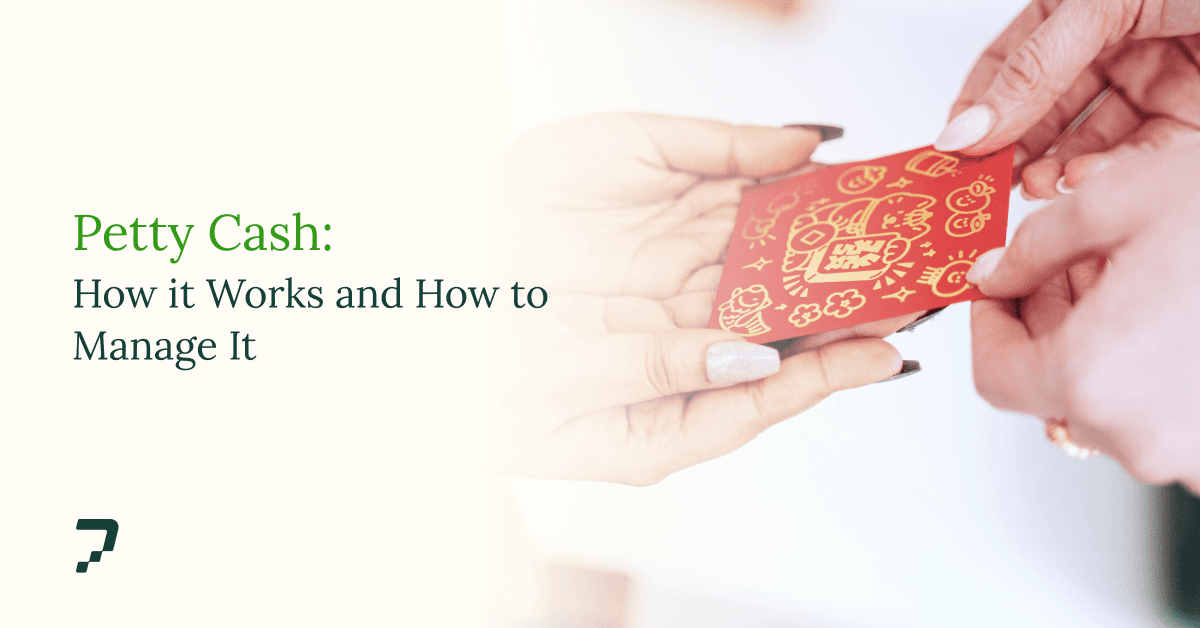
Oftentimes, a finance team has a drawer or safe with a small amount of cash set aside for everyday expenses, such as Grab rides to a client meeting, food for a team that stayed late, or small fees from vendors who only accept cash.
These are all common examples of petty cash. For a lot of small businesses, it works well enough, until it doesn’t.
This article will walk you through how petty cash works, how to manage it properly so it holds up during a BIR audit, and how to tell when your business may have outgrown it.
What is petty cash?
Petty cash is a small amount of physical money a business keeps on hand to pay for minor expenses that are too small or inconvenient to go through the usual payment process. Instead of writing a check or filing a purchase request for a ₱120 parking fee, someone takes the money from the fund, pays, and brings back the receipt.
The key word is “small.” Petty cash is not meant for rent, supplier invoices, or payroll. It is intended for everyday expenses that would otherwise add dozens of small transactions to your accounting records each month.
In accounting terms, petty cash is a current asset. It sits on the balance sheet as cash. When the money is spent, the amount is recorded under the appropriate expense account, such as office supplies, transportation, or meals.
How a petty cash fund works
Think of petty cash as a box that always stores the same amount, just in two forms: cash and receipts.
Say you start with ₱5,000. Your team spends ₱3,200 over two weeks and keeps every receipt. Now the box has ₱1,800 in cash and ₱3,200 in receipts. To refill it, you take out the receipts, record them as expenses, and put in ₱3,200 in cash. You are back to ₱5,000 and ready for the next round.
Here’s how you can manage petty cash efficiently:
- Set the fund amount: Pick an amount that covers roughly two to four weeks of small purchases. For a small office or store in the Philippines, this is often ₱3,000 to ₱10,000. The right amount depends on how often your business uses petty cash.
- Assign a custodian: One person holds the cash and is accountable for it. Usually this is an admin officer, office manager, or a trusted senior staff member. Ideally, the owner or another authorized person should review the fund rather than manage it directly.
- Release money against a petty cash voucher: When someone needs cash, they fill out a voucher with the date, amount, purpose, and their signature. The custodian approves it and hands over the money. This is the paper trail that matters most.
- Collect the receipt: The person brings back the official receipt or sales invoice and any change. The custodian staples the receipt to the voucher. If there is no receipt (a jeepney fare, a tip), the voucher itself becomes the supporting document, with a note explaining why.
- Replenish: When the cash runs low, the custodian totals all vouchers, prepares a replenishment request, and submits it to the owner or accountant for approval. The fund is topped back up to the original amount.
- Reconcile: Regularly, and always at replenishment, someone other than the custodian counts the cash and checks that cash plus receipts equals the fund amount. Any gap gets recorded as cash over or short and investigated.
What a petty cash voucher should include
A petty cash voucher keeps track of each cash withdrawal and the expense it was used for. A good one has:
- Voucher number (sequential, so you can spot missing ones)
- Date of release
- Name of the person receiving the cash
- Amount in figures and in words
- Purpose or description of the expense
- Expense account or category
- Signatures of the requester, the custodian, and the approver
You can buy pre-printed petty cash voucher booklets at any National Bookstore, or print your own. Either works, as long as each cash withdrawal is properly documented with a voucher.
What can and cannot be paid from petty cash
Set the rules in writing before handing out cash. A typical petty cash policy for a Philippine SME allows things like transportation and parking, office supplies and small hardware, courier and LBC fees, meals during overtime or client meetings, minor repairs, and postage and notarial fees. It usually excludes anything above a per-transaction cap (₱1,000 or ₱2,000 is common), supplier payments, salaries or cash advances to staff, personal purchases, and anything that could be paid by bank transfer instead.
The per-transaction cap is your friend. It forces larger purchases into a process where someone actually reviews them before the money is spent, not after.
Petty cash and the BIR: what Philippine businesses need to know
Petty cash may be small, but it still needs to be accounted for.
For Philippine businesses, an expense doesn't become deductible just because someone paid for it using petty cash. If you want to claim it as a business expense, you need to be able to show that it was a legitimate business expense and support it with the right documentation.
In general, deductible business expenses must be ordinary and necessary, related to the business, and properly substantiated. That means keeping the documents that show what was purchased, how much it cost, and who sold it.
Start with the invoice
Under the Ease of Paying Taxes (EOPT) Act, invoices are now the primary document for sales of goods and services. BIR Revenue Regulations No. 7-2024, as amended by RR No. 11-2024, distinguish invoices from supplementary documents such as official receipts, delivery receipts, and acknowledgement receipts.
For accountants, it’s important to ask for an invoice whenever you make a purchase for the business, and keep it with the petty-cash voucher.
The invoicing requirement depends on the seller's tax registration and the amount of the transaction. VAT-registered sellers generally need to issue a VAT invoice regardless of the amount. For non-VAT sellers, the general threshold is ₱500, although a seller must issue an invoice if the buyer requests one, even for a smaller transaction.
This is why a handwritten note saying “snacks – ₱450” isn't a substitute for the seller's invoice. The petty-cash voucher documents why your business released the money; the seller's invoice documents what your business actually purchased.
Keep the voucher and the supporting document together
A good petty-cash trail should make it easy to answer three questions: What was the money spent on? Who received or spent it? What document proves the purchase?
That's where the petty-cash voucher comes in. It should identify the date, amount, purpose of the expense, person who received the cash, and the relevant approvals. Attach the supplier's invoice or other supporting documentation to the voucher.
Your bookkeeper can then record the transaction under the appropriate expense account and reconcile the petty-cash fund when it is replenished.
For example, when a ₱5,000 petty-cash fund is replenished, the accounting entry will generally recognize the relevant expenses and credit cash in bank for the amount transferred to restore the fund. The vouchers and supporting invoices provide the audit trail behind those entries.
How long should you keep the records?
This is another area where older advice can be misleading.
Under the EOPT Act, the general retention period for books of accounts and other accounting records under Section 235 of the Tax Code is now five years, counted from the day following the deadline for filing the relevant return, or from the actual filing date if the return was filed late.
That replaced the previous 10-year retention period under BIR Revenue Regulations No. 17-2013.
Businesses should therefore keep their petty-cash vouchers, invoices, and related accounting records organized and accessible for the applicable retention period.
Petty cash doesn't need to be complicated. A voucher tells you where the money went. The invoice helps prove what the business paid for. Keeping both together makes your books easier to reconcile and your expenses easier to substantiate if the BIR ever asks questions.
Common petty cash problems
By design, cash is harder to control and trace than other types of business spending. Here are the common problems faced by accountants in relation to petty cash, so you know what to expect and avoid:
- Missing receipts: The single most common issue. Someone buys something, loses the receipt, and the voucher says "supplies" with no backup. Multiply that by fifty transactions a month and you have a chunk of expenses you cannot deduct.
- Vouchers filled out after the fact: Cash goes out on Monday, the voucher gets written Friday when the custodian remembers. Amounts get rounded, purposes get vague, and the paper trail stops matching reality.
- Cash over or short: The count comes up ₱340 short. Nobody knows why. It gets written off. Then it happens again next month.
- Petty cash as an ATM: Staff "borrow" from the fund for personal needs and pay it back on payday. Even when every peso returns, this breaks the system and makes reconciliation meaningless.
- Owner bottleneck: In a lot of small businesses, the owner is the custodian. That means approvals wait until they are in the office, and nobody is independently checking the fund. It would be best to have multiple checks on something that would eventually be handed to the BIR.
- One box, many branches: Once you have a second location or a field team, petty cash multiplies. Each branch needs its own fund, custodian, vouchers, and reconciliation.
None of these are fixed by a better voucher template. They are structural problems with using physical cash for business spending.
When to stop using petty cash
Petty cash makes sense when your team is small, purchases are rare and tiny, and you personally see most of what happens in the business.
If you replenish twice a month or more, the volume of small spending has outgrown a cash box. You are also spending real staff hours counting bills and stapling receipts.
Here’s another instance: if employees regularly pay out of pocket and file expense reports, you already know petty cash is not covering the need. Reimbursement is the same problem with extra paperwork.
Additionally, repeated cash-short results, even small ones, mean the control is not working. At some point the cost of investigating exceeds the amount missing.
Petty cash lives outside your digital records until someone manually enters it. That lag is fine for a sari-sari store. It is a problem for a growing company making decisions on cash flow.
Lastly, if many of your vendors are paid online, such as subscriptions, ad spend, domain renewals, and online supply orders, these shouldn’t be paid with cash from your safe. If your team is using the owner's personal card for these, you have a different kind of problem.
What replaces petty cash
The modern replacement is not a bigger safe. It is giving people a controlled way to pay directly, with spending limits set in advance and every transaction recorded automatically.
For most Philippine SMEs, that means a business card, much better a virtual card that’s easy to access. A virtual card is a card number that lives in an app or dashboard instead of on plastic.
You can create one per employee, per team, or per purpose, set a spending cap on each, and see every transaction the moment it happens. Because the receipt trail is digital, the missing-receipt problem shrinks dramatically. Because the limit is enforced by the card itself, the per-transaction cap stops being a rule people follow and starts being one they cannot break.
Corporate credit cards from banks do this too, but they usually require a credit line, a minimum deposit, and paperwork that assumes you are a mid-sized company. That is why prepaid virtual cards have become the practical option for smaller businesses.
Here is how the two stack up on the things that actually go wrong.
How PayMongo Virtual Cards work
If you already accept payments through PayMongo, the money coming in lands in your PayMongo Wallet. PayMongo Virtual Cards let you spend from that wallet directly using Mastercard-powered prepaid cards, with no credit line and no separate bank account required.
Each card you issue draws from the same wallet, each has its own cap, and every purchase shows up in your dashboard with the merchant name, amount, and time details. Reconciliation becomes a matter of matching a digital list to receipts instead of counting bills and recording manually.
You can issue a live virtual card in under five minutes, and cards can go to team members, and even freelancers/contractual workers who do not have their own bank accounts. Cards are managed from the same PayMongo dashboard used for payments and payouts.
That said, you don’t have to eliminate petty cash from your accounting process entirely. Plenty of businesses keep a small float for the small category of expenses, while moving everything else to cards. The point is to make cash the exception rather than the default.
How to run petty cash well while you still have it
If you are not ready to switch, or you are keeping a small fund alongside cards, a few habits make the difference.
Keep the fund small and the cap low. Use numbered vouchers and file them in sequence. Have someone who is not the custodian do surprise counts. Replenish on a fixed day so the reconciliation happens on schedule rather than when someone notices the box is empty.
Insist on BIR-registered invoices, and flag vendors who cannot issue them. Record replenishments promptly so your books reflect real spending. And review the petty cash log monthly for patterns: the same vendor appearing constantly, amounts clustering just under the cap, purposes that are always vague.
Ready to move your small spending off the cash drawer?
PayMongo Virtual Cards let you give your team controlled spending power funded directly from your PayMongo Wallet. Set the limit, issue the card, and watch every transaction land in your dashboard in real time. No credit check, no bank paperwork, no missing receipts stapled to vouchers.
Frequently asked questions about petty cash
What is petty cash used for?
Petty cash covers small, everyday business expenses that are impractical to pay by check or bank transfer. Typical examples in the Philippines include transportation fares, parking, office supplies, courier fees, meals during overtime, and minor repairs. It should not be used for supplier invoices, payroll, or employee cash advances.
How much petty cash should a small business keep?
Enough to cover two to four weeks of small purchases. For most Philippine SMEs that lands between ₱3,000 and ₱10,000. If you are replenishing more than twice a month, the fund is either too small or the business has outgrown petty cash altogether.
Is petty cash an asset or an expense?
Petty cash is a current asset. The fund itself sits on the balance sheet as cash. Individual purchases made from it are recorded as expenses when the fund is replenished and the vouchers are booked.
Can petty cash expenses be deducted from income tax in the Philippines?
Yes, if they are ordinary and necessary business expenses supported by BIR-registered invoices or receipts. Purchases with no valid supporting document, or from vendors who are not BIR-registered, generally cannot be claimed as deductions.