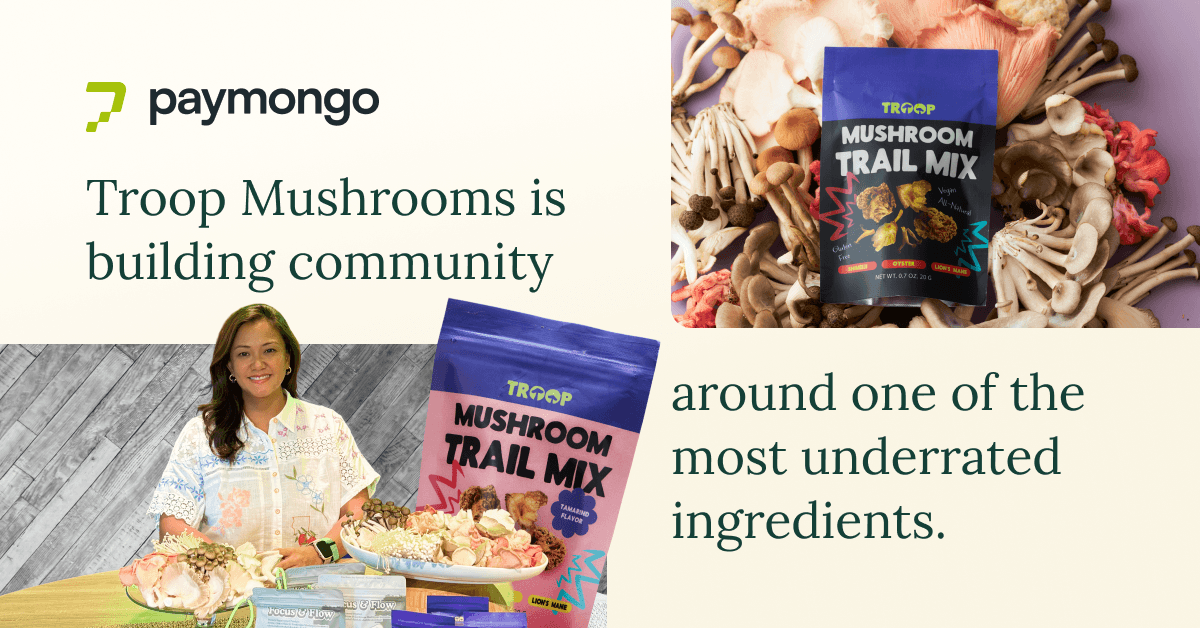
Finina Marie Tugade-Castillo will tell you upfront: she's a mushroom enthusiast. She says it without apology, and she means it as an invitation.
The nine-year passion project that became Troop Mushrooms began with a documentary — Paul Stamets' Fantastic Fungi — and a childhood spent in Canadian summers with mushrooms everywhere, alive in ways most people never stopped to notice. Finina knew this and couldn't unknow it.
What she built from that curiosity is one of the most quietly radical businesses in the Philippine wellness space: a company that positions mushrooms not as a trend, but as a system — for health, for ecosystems, for community.
Something Else Entirely
Most people's relationship with mushrooms starts and ends at the grocery aisle: oyster mushrooms packed in plastic wrap and styrofoam, sitting in a puddle of their own moisture.
"When you're going to buy them to eat, you want them dry," she says. Mushrooms absorb moisture so readily that the wet packaging most people recognize as "fresh" is actually the opposite of what you want. It's the kind of thing that seems like a small detail but tells you everything about how much more consumers can understand about what they're buying.
Mushrooms aren't plants or animals. They exist in a category of their own, and what they can do is far more varied than most people realize. Food, medicine – even poison. They can clean pollution, break down waste, and fundamentally transform the environment they live in. In the wild, cordyceps grow on the bodies of ants (or insect hosts). A lion's mane looks like a white shaggy cloud and is known to support neurological health. Reishi — known locally as Kabuteng Kahoy — grows wild across the Philippines, largely uncollected, its potential sitting untapped in the forest.
Finina talks about all of this with the ease of someone who's been living inside the subject for nearly a decade. She believes that once the door to understanding what mushrooms are capable of, the question of why we aren't using them more becomes harder to ignore.
Introducing the Adaptogen
Troop's origin as a business is inseparable from Finina's personal experience with mushrooms.
She was drinking eight cups of coffee a day to manage her post-childbirth brain fog, a demanding schedule, and the compounding exhaustion of running a life and a business simultaneously. Connecting with someone in the mushroom supplement space introduced her to lion's mane, and she started taking it.
Adaptogens, which are found in mushrooms and help restore internal balances, take time to build (it takes some time before you noticee the benefit), and work by reading your body's needs rather than overriding them.
"It takes a look at your body composition and releases exactly what it needs," Finina explains. By the time she'd been taking lion's mane consistently, she was off caffeine entirely.
Her conviction is what drove Troop from a personal interest into a business built on the belief that more Filipinos should have access to quality mushroom products — not watered-down supplements full of dextrin starch filler, but the real thing, sourced with integrity.
For Everyone
The word Finina uses most often when talking about Troop's products is everyone.
It comes up when she talks about the December pantry line launch: mushroom longganisa, mushroom falafel, three varieties of mushroom pâté, mushroom crackers, and a mushroom noodle kit. "It's not just for vegans," she says. "It's for everyone who just loves mushrooms or wants to try something new." The pantry line is designed to show up in a Filipino kitchen without requiring anyone to change how they eat.
It comes up when she talks about the five-year vision: lion's mane coffee in local cafes, cordyceps tea pre-workout drinks, mushroom-based non-alcoholic beverages for a generation that's drinking less alcohol. "The goal is to create a drink that feels satisfying and nourishing," Finina says — not just satisfied, but genuinely healthier for having chosen the drink.
And it comes up in the name itself. A troop is the collective noun for a group of mushrooms. It's also what Finina found, over years of visiting farms and meeting practitioners around the world: a community of people in the wellness mushroom space who opened their doors without hesitation, shared knowledge freely, and treated every newcomer as someone worth helping. "Every single person opened their doors to us," she says. That culture shaped what Troop is trying to build locally.
Finina describes the mushroom community as collaborative rather than competitive. Rather than white-labeling everything and building a moat around proprietary products, Troop operates as a hub: carrying partner brand supplements (currently from Earthling Farm an urban farm in Bangkok run by two brothers, Alex and Sam). Their process in growing their own mushrooms produces supplements such as gummies and capsules that are 1:16 ratio of mushroom content, which no one in the industry offers yet. Pink oysters, gray oysters, chestnut mushrooms, lion's mane — premium, dry, the way they're supposed to be.
The goal is for the mushroom industry in the Philippines to grow and flourish.
Untapped Potential
Volvariella, the mushroom used in tom yum soup, grows naturally on banana trunks. Banana trunks that the Philippines has in abundance, because the Philippines exports the fruit to the world. The mushroom that requires specialist cultivation in Thailand grows itself here, practically untouched.
Kabuteng kahoy— reishi — grows across the archipelago, wild and untouched. A functional mushroom with documented health properties, sitting in the forest because there's no processing infrastructure to turn it into something a consumer can buy.
"We have a lot of Philippine wild mushrooms," Finina says. "But how come we don't eat them or offer them in our groceries?" She asks genuinely. The answer is that the supply chain, the processing knowledge, and the market education to support a local mushroom industry are all still nascent — which is precisely why Troop exists.
"If we can get more companies to get into it, then the mushroom industry would get bigger and more exciting," she says. Rather than dreading a competitive environment for the industry, she welcomes it.
The Infrastructure for a Movement
Troop's relationship with PayMongo predates Troop itself. Having come from a tech background herself, Finina was evaluating payment gateways when the company was still in earlier form. PayMongo stood out for a specific reason: no minimums, no high-commitment contracts, no red tape between a small business and its first transaction.
"Let's say we just need a QR code so that our small business can start selling something," Finina explains. "You sign up and you can start accepting immediately." For a business in its early stages — still building supply chains, still educating a market that's never thought about mushroom supplements — that frictionless entry is the difference between starting now and starting later.
Jam Abella, Troop's accountant, handles the operational side of the PayMongo dashboard. She exports financial records for internal reporting, tracks incoming payments against orders, receives real-time notifications when transactions complete, and reconciles everything against the website's payment integration. The dashboard is clean, detailed, and easy enough to navigate that the data actually gets used rather than sitting in a spreadsheet somewhere.
"Very easy to navigate and very straightforward," Jam says. The fund transfer to their bank account works reliably. The transaction breakdown is clear. For a business where Finina is still the primary driver of everything from product development to brand strategy, having a financial layer that just runs in the background — accurately, without demanding attention — frees up the crucial bandwidth.
QRPH is the primary payment method, handling both online and showroom transactions. The accessibility that drew Finina to PayMongo in the first place — no fees on the customer side, no friction at the point of payment — aligns with exactly what Troop is trying to do for mushrooms: make access as easy as possible for as many people as possible.
"So much like Troop," Finina says, comparing the two directly, "you guys are also synergized with everyone else." It's a generous read, but it's accurate: the same philosophy that makes Troop operate as a hub rather than a closed ecosystem is what makes PayMongo work as a platform rather than a proprietary channel. Both are in the business of making the infrastructure available, then letting the community build on top of it.
On a Mission
Troop Mushrooms is the kind of merchant PayMongo exists to support: a mission-driven business with serious conviction, needing financial infrastructure that can keep up without slowing them down.
No minimums. QRPh that works in a showroom and online. A dashboard that gives Jam what she needs to keep the books accurate and the business decisions grounded in real numbers. It all serves the same end: making it as easy as possible for Troop to focus on what it's actually here to do — grow the mushroom industry, bring more Filipinos into the community, and make the case that this ingredient, in all its forms, belongs in every kitchen, every cafe, and eventually every grocery aisle in the country.
"You have to love what you do," Finina says. "Then it won't feel like work, and you'll be successful — whether that's profit, or a mental thing, or a wellness thing."
And maybe, she adds with a laugh, call PayMongo if you need a payment gateway.
Troop Mushrooms is a PayMongo merchant based in the Philippines, offering mushroom supplements, tinctures, and fresh specialty varieties. -Follow them and look out for their October City Forage event @troop.mushrooms and www.troopmushrooms.co