From Idea to Live in Minutes with Storefront AI
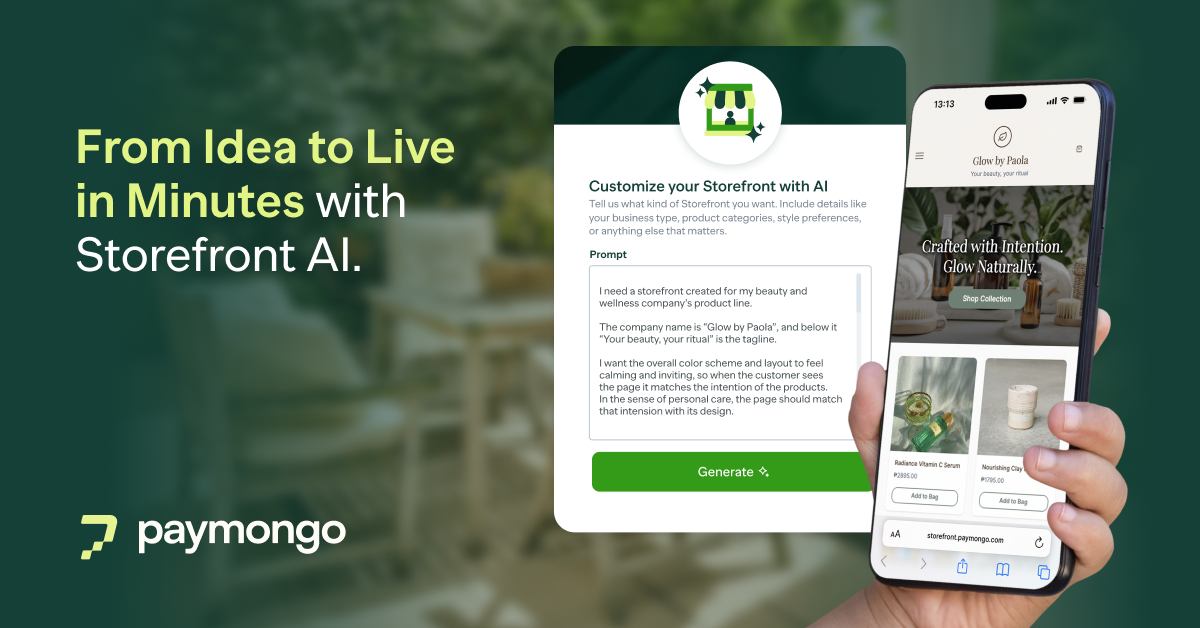

Table of Contents
For many small businesses, selling begins in the tedious tracking of orders in chat, confirmation of payments by hand, and reconciliation at the end of a long workday.
PayMongo introduced Links and Pages: faster ways to get paid, without the overhead of building a site.
Now, we bring you Storefront AI: the next step in a progression that compresses operations even further while providing reliable organizational infrastructure as volume grows. It closes two of the most common gaps SMEs face as they scale: how their business looks to customers, and how their orders are managed behind the scenes.
This upgrade it’s about deliberately removing the unnecessary work that slows businesses down, enforcing a system where operations stay coherent and growth doesn’t threaten output quality.
AI as Compression
AI is most useful when it collapses decisions.
The new Storefront AI update is built around that idea. Instead of forcing merchants to choose between speed and credibility, it compresses design decisions into a single action: describe what you’re selling, and let the system translate intent into results.
Under the hood, our resources have been upgraded across the surfaces that shape first impressions:
- More adaptive fonts and typography systems
- Cleaner, more contemporary stock imagery
- Expanded layout options with clearer hierarchy
- More accurate prompt interpretation, narrowing the gap between intent and output
For SMEs moving from experimentation to consistency, this is the difference between selling online as a workaround and running it as a system—one that supports both momentum and control.
Generation can take up to a minute, but the outcome is meaningfully different. The storefronts feel less improvised and more deliberate—closer to something you’d confidently share, not just test with.
Prompting with Intent
Compression only works when intent is clear.
Storefront AI works best when prompts reflect real commercial intent, not vague aesthetic preferences. Instead of asking for something that “looks modern” or “feels premium,” merchants get stronger results when they describe what they’re trying to sell and how customers should move, rather than how they want the site to feel.
Effective prompts typically share these traits:
- Clear business context. Describe the product category, price range, and customer type. The AI responds better when descriptions are explicit.
- Specific tone and use case. Prompts that mention whether the storefront is meant for quick social selling, catalog-style browsing, or a seasonal campaign produce layouts with more appropriate hierarchy and pacing.
- Simple, concrete language. Short, direct descriptions outperform long, abstract ones. Storefront AI is optimized to translate intent into structure, not interpret metaphor.
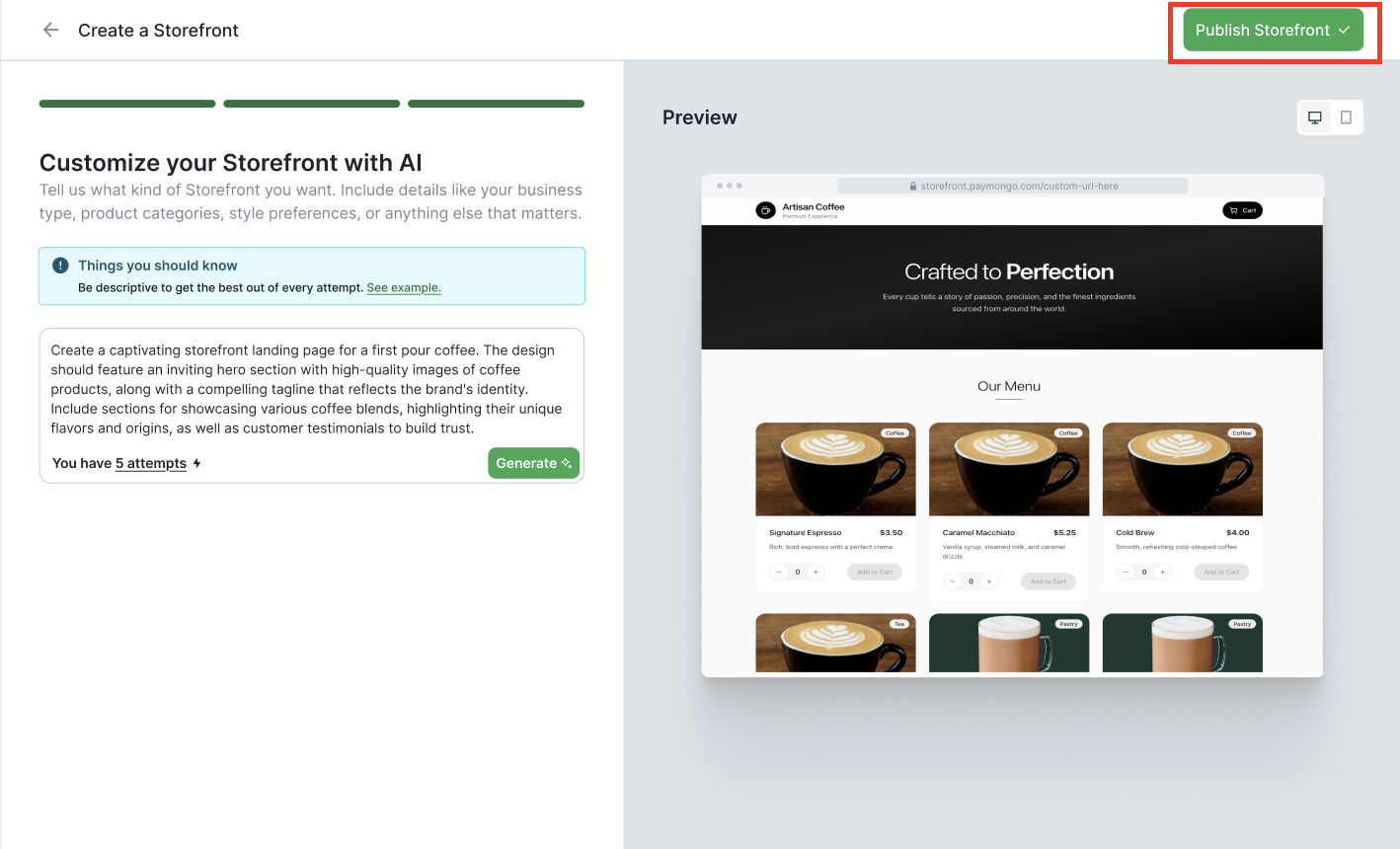
Merchants are also encouraged to iterate. Generating multiple versions, adjusting a single variable at a time, such as layout preference or brand mood, often leads to clearer improvements than rewriting an entire prompt from scratch.
To lower the cost of experimentation, PayMongo is issuing fresh Storefront AI credits to all merchants, making it easier to test, iterate, and relaunch with confidence.
Below are examples of our merchants who have successfully applied the new Storefront AI to their digital storefronts:
Crafts & Chest


Wooden Inspirations


Silhay


As Storefront AI becomes more design-aware, prompting shifts from “hoping for a good result” to directing a system. The businesses that benefit most are the ones that treat storefront creation as an extension of how they already think about their brand and customers.
For a deeper breakdown, PayMongo has published detailed guidance on how to structure prompts and avoid common pitfalls in the Storefront AI guidelines.
Improving Operational Management
Design is only half the compression problem. The other half shows up after the first peso comes in.
As businesses sell through various channels, order data fragments. Suddenly, what felt manageable at ten transactions becomes brittle at a hundred.
The new Customers API addresses that complexity.
It consolidates customer orders into a single view across Links, Pages, Storefront, Shopify, and more. This means tracking, reconciliation, and day-to-day operations stay coherent even as channels multiply. What’s more, this promotes alignment and clarity while avoiding letting any money movement slip through any cracks.
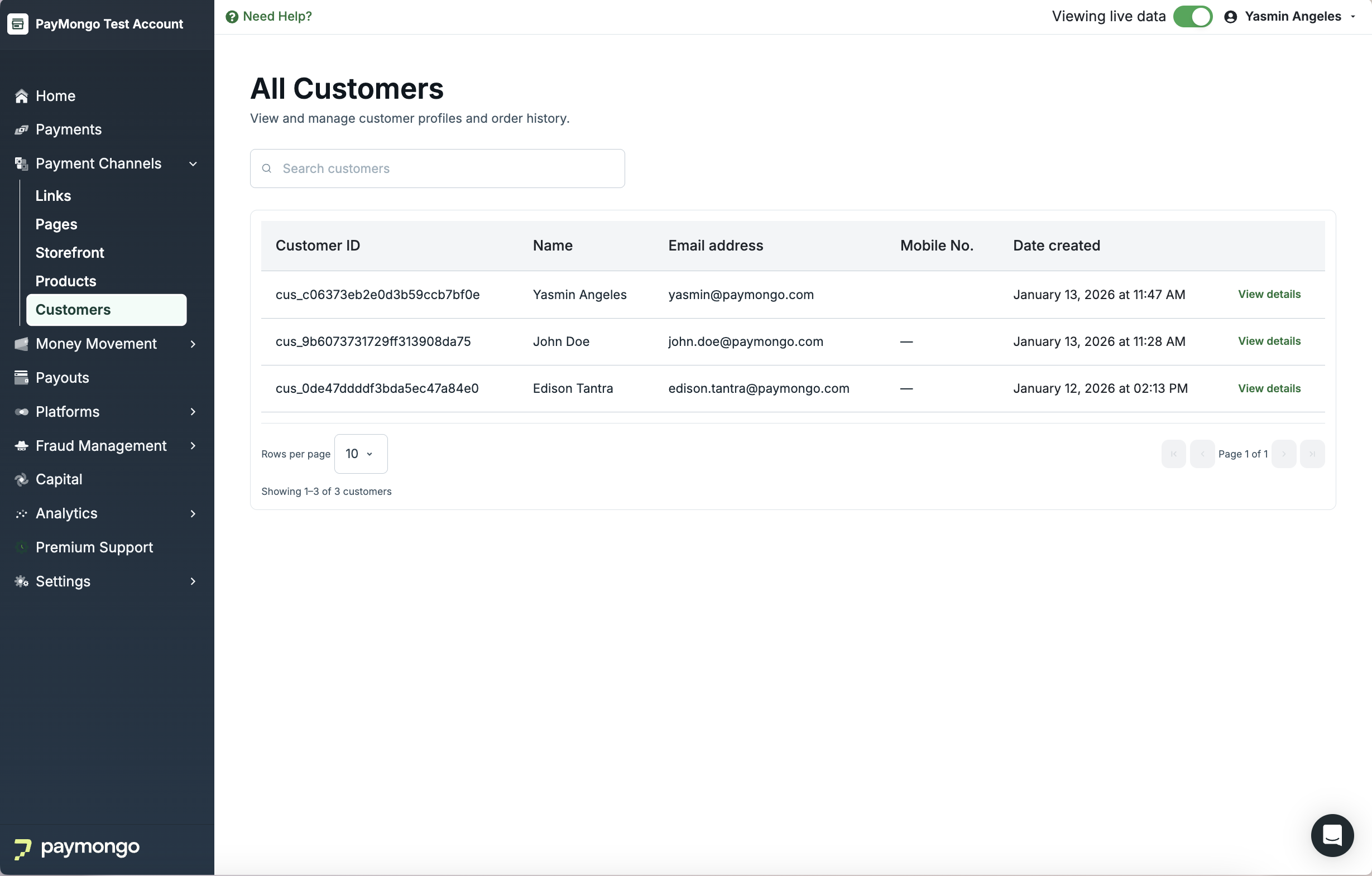
This is not a cosmetic feature. It is an infrastructure layer for growing teams that need visibility and control as volume increases.
Having this tool provides your business with the following:
- One source of truth. Teams *avoiding duplicate work and internal misalignment as volume grows.
- Faster operations without adding to headcount. Centralized order tracking and reconciliation compress the time spent on manual checks, follow-ups, and reporting.
- Cleaner handoffs between teams. Questions get resolved faster, ownership is clearer, and growing teams avoid the fragmentation that usually appears when new channels are added.
By reducing manual work, errors, and blind spots, we’re freeing operators to focus on fulfillment, inventory, and customer experience. Learn more at our Customers page.
The Combined Effect
The real shift happens when speed no longer comes at the cost of control.
Storefront AI gives businesses a digital presence they can confidently share from the first sale onward. The Customers API ensures that everything behind that storefront—orders, customers, reconciliation—stays organized as demand increases. Together, they allow merchants to move quickly without outgrowing the system that supports them.
Discover how fast you can go from idea to live, and how stable infrastructure gives you more room to focus on growth.
Sign up for free to start building with Storefront AI, or access quicker configuration as an existing merchant through this Storefront AI request form.
To explore PayMongo’s full product suite, visit https://www.paymongo.com or reach out to support@paymongo.com.
Subscribe to the PayMongo Blog
Join thousands of business owners in getting the latest financial insights