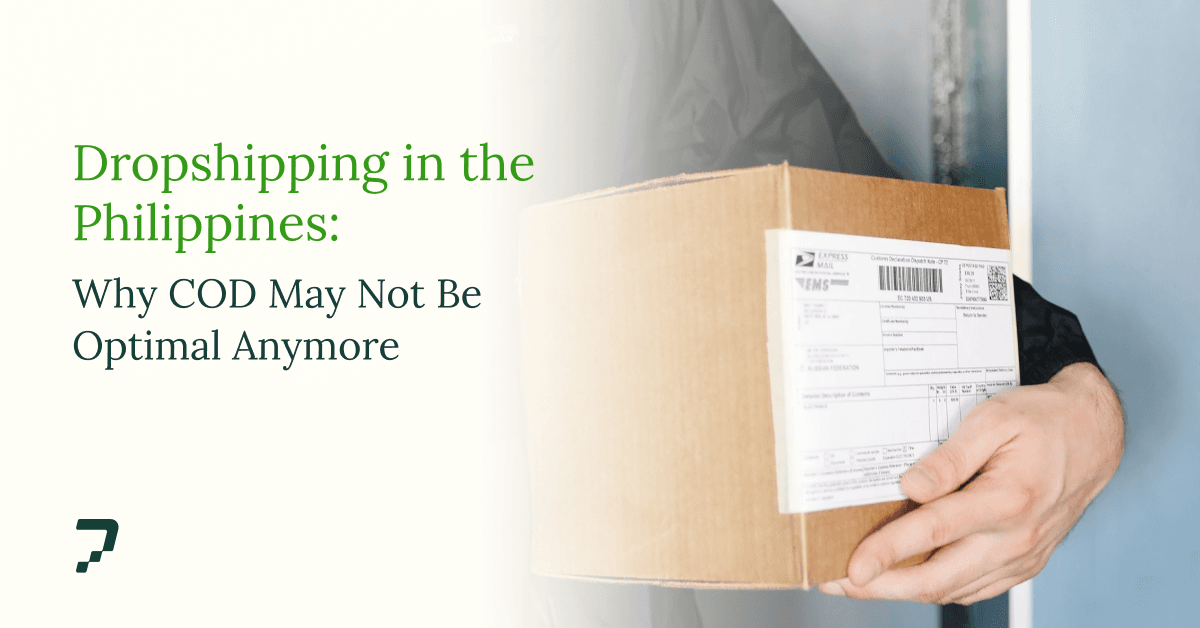
You found a supplier. You built the store. You ran the ads. Then a Php1,200 order comes in, you pay the supplier upfront, the courier delivers it, and the customer refuses to accept the package.
You just paid for the product, the shipping out, and the shipping back. You earned nothing.
That is the hidden math of cash on delivery, and it remains a major payment option for dropshipping businesses in the Philippines. But the ground has shifted. Digital payments made up 64.7% of retail payment volume in 2025, up from 57.4% the year before. The 2025 figure was the first to reach the Bangko Sentral ng Pilipinas’ newer 60–70% target range, although digital payments had already surpassed the earlier 52–54% target in 2024.
This guide covers how dropshipping works in the Philippines, what you legally need to operate, and why the payment method you default to matters more than your supplier.
How dropshipping works in the Philippines
Dropshipping is a retail model where you sell products you never physically hold. When a customer orders from your store, you forward the order to a supplier, and the supplier ships it directly to the buyer. You never touch inventory.
The appeal is obvious. There is no warehouse, no upfront stock purchase, and no dead capital sitting in unsold products. For a Filipino entrepreneur starting with limited capital, it is one of the lowest-barrier ways into e-commerce.
The local version has three common shapes:
- Local supplier dropshipping. You source from a Philippine-based supplier or distributor. Delivery takes 2–5 days, and returns are manageable.
- Cross-border dropshipping. You source from overseas suppliers, often through platforms like AliExpress or CJ Dropshipping. Margins can be better, but shipping takes weeks and customs can complicate things.
- Marketplace dropshipping. You list on Shopee, Lazada, or TikTok Shop and fulfill through a supplier. The platform handles payments and takes a cut.
The model you pick changes your delivery times. It does not change the core problem: you pay your supplier before your customer pays you.
Is dropshipping legal in the Philippines?
Yes. Dropshipping is a legitimate retail model and there is no law prohibiting it. But operating as a business carries the same obligations as any other seller.
At minimum, you will generally need:
- Business registration. Sole proprietors register with the Department of Trade and Industry (DTI). Partnerships and corporations register with the Securities and Exchange Commission (SEC).
- BIR registration. You need a Certificate of Registration, official receipts or invoices, and you must file and pay taxes on your income.
- Local business permits. Mayor's permit and barangay clearance from your local government unit.
You are also bound by the Consumer Act of the Philippines (RA 7394) and the E-Commerce Act (RA 8792). In practice, that means the customer's contract is with you, not your supplier. If the item arrives broken, late, or not as described, you are the one accountable, even though you never saw the product.
This matters for payments too. Most legitimate payment providers require business registration before they will let you accept card and e-wallet payments. Registration is not red tape you can skip; it is the thing that unlocks the payment methods that actually protect you.
The COD default, and what it actually costs you
Cash on delivery became the norm in Philippine e-commerce for a good reason. Trust was low, card penetration was low, and COD let buyers pay only after seeing the goods. It solved a real problem.
But for a dropshipper specifically, COD is the worst possible arrangement. Here is why.
You finance every single order
In dropshipping, you pay your supplier when the order is placed. With COD, you get paid after delivery, and then only after the courier remits to you, which can take one to two weeks depending on the logistics partner.
So your money goes out on day one and comes back on day fifteen. Every order you win makes your cash position worse until the remittance lands. Growth actively starves you. Sell twice as much and you need twice as much working capital to survive the gap.
Return-to-sender destroys your margin
The cost of COD is not just payment collection. Failed deliveries, refusals, unreachable buyers, and repeat delivery attempts can turn apparently successful orders into shipping and handling losses. Industry estimates suggest COD failure rates in Southeast Asia are materially higher than those for prepaid orders, but merchants should benchmark the gap using their own delivery data.
Your cash sits with someone else
Between delivery and remittance, your revenue is on a courier's balance sheet, not yours. You cannot reinvest it, restock with it, or spend it on ads. You are effectively extending an interest-free loan to your logistics provider on every order.
You can't forecast anything
With COD, an order is not revenue, it is a maybe. You cannot reliably predict cash flow, plan ad spend, or know your real margin until weeks after the sale. Prepaid orders are settled facts. COD orders are estimates.
The shift is already happening
Here is the part most dropshipping guides miss: the reason Filipinos used COD is disappearing.
The BSP's 2025 figures tell the story clearly:
The headline for online sellers is QR Ph. In 2025, QR Ph transaction volume overtook combined debit- and credit-card transaction volume for the first time. Filipinos are not merely paying digitally; they are increasingly using interoperable, account-based payment methods that have scaled rapidly in recent years.
BSP Governor Eli M. Remolona Jr. attributed much of the growth to interoperability: “A lot of the growth is due to our insistence on interoperability, ensuring that a growing number of businesses and service providers are on one system.”
If you still default to COD in 2026, you may be designing your checkout around an assumption that is becoming less reliable: that customers need cash on delivery to complete a purchase. Digital adoption is rising, but sellers should compare prepaid conversion, COD acceptance, cancellations, and return-to-origin rates using their own store data before removing COD altogether.
What to offer instead
You do not need to eliminate COD overnight. You need to stop making it the path of least resistance. Give buyers a prepaid option that is genuinely easier than waiting for a courier with exact change.
QR Ph
The national QR standard, now the highest-volume digital rail in the country. It works across banks and e-wallets, so one QR code reaches nearly every digitally active Filipino. For a dropshipper, this is the single highest-leverage method to add.
E-wallets
GCash and Maya are how a large share of Filipinos already transact online. Accepting them removes the "I don't have a card" objection entirely. Here's how to accept GCash payments.
Buy Now, Pay Later
A lot of online sellers and eCommerce sites provide Buy Now, Pay Later as an option, which is becoming increasingly popular in the market. You get paid by the provider right away while the customers pay them their installments.
Cards
Visa and Mastercard still matter for higher-value orders and for customers who want the chargeback protection a card gives them.
Online banking
Direct debit from BPI, UnionBank, and other banks captures buyers who prefer moving money straight from their account.
And if you keep COD, price it properly
Charge a COD handling fee that reflects your real return risk, or offer a small discount for prepaid orders. Make the economics visible instead of absorbing them silently.
Offer payment options by sending one link
The practical move is to accept all of these through one checkout rather than stitching together separate accounts. PayMongo's accept payments suite covers cards, e-wallets, QR Ph, and online banking in a single integration, and Payment Links lets you collect pre-payment without building a website at all, useful if you sell through Facebook, Instagram, or Viber.
If you sell from your own website, you may integrate a Hosted Checkout or Payment Page to enable your customers to checkout instead of manually sending you screenshots or paying upon delivery.
How to actually move buyers off COD
Adding payment methods is not enough. You have to redesign the decision.
- Put prepaid options first. Order matters. If COD is the top radio button, most people will pick it without thinking.
- Offer a prepaid incentive. A 3–5% discount or free shipping for prepaid orders usually costs less than your COD return rate.
- Build trust visibly. Clear return policy, real contact details, and visible reviews remove the fear that made COD necessary in the first place.
- Try partial prepayment. Ask for a deposit that covers your supplier cost, with the balance on delivery. You stop financing refused orders.
- Cap COD by value. Allow COD under a threshold, require prepayment above it. Your biggest losses come from your biggest orders.
Stop paying for orders that never get paid
Every refused COD package is money you already spent on a customer who never became one. The fix is not a better supplier or a tighter ad set; it is getting paid before the parcel leaves.
PayMongo lets Philippine businesses accept QR Ph, GCash, Maya, cards, online banking, and BNPL through one account, so your customers pay at checkout instead of at the door. No inventory risk, no remittance wait, no return-to-sender write-offs.
Create a free PayMongo account and start collecting prepaid orders today. See pricing – no setup fees, no monthly fees.
The takeaway
Dropshipping in the Philippines works, but the margins are thin enough that your payment method decides whether the business is viable. COD forces you to fund every order, wait weeks to get paid, and absorb a double-digit return rate you did not price for.
Meanwhile, most Philippine retail payments are already digital, and QR Ph has overtaken cards. The customer behaviour has shifted, and you may find that the stores that move with it are keeping their margins.
Start by adding prepaid options and putting them first at checkout. Everything else follows from getting paid on time.
Frequently asked questions
Is dropshipping legal in the Philippines?
Yes. Dropshipping is legal, but you must register your business with the DTI (sole proprietor) or SEC (partnership or corporation), register with the BIR, and secure local permits. You are also responsible to the customer under the Consumer Act, even though your supplier ships the product.
How do I start dropshipping in the Philippines?
Pick a niche, find a reliable supplier, register your business, set up an online store or social selling channel, and connect a payment method so you can accept prepaid orders. Sorting out payments early matters more than most guides suggest. It determines your cash flow from your very first sale.
Can I do dropshipping without cash on delivery?
Yes, and increasingly you should. With digital payments at 64.7% of Philippine retail volume, most customers can pay online. Offering QR Ph, GCash, Maya, cards, and online banking gives buyers a prepaid option and removes your exposure to refused deliveries.
What is the best payment method for dropshipping in the Philippines?
Prepaid digital payments — QR Ph, e-wallets, and cards — are the strongest fit, because you get paid before you pay your supplier. QR Ph is especially useful since it became the highest-volume digital rail in the country in 2025, reaching customers across both banks and e-wallets.
How much does it cost to accept online payments in the Philippines?
Payment providers typically charge per successful transaction rather than a monthly fee, with rates varying by method. Check current PayMongo pricing for the exact rate per payment type.